
Everful announced a $48.5 million Series A on November 19, led by Vertex Ventures Southeast Asia & India and January Capital, with existing investors Square Peg and Lightspeed participating. The San Francisco- and Singapore-based company connects smaller retailers and brands with factories in China, coordinating orders through delivery. Co-founder Sisi Song says the company is on track to reach $100 million in annualized revenue by year-end. Everful also reports shipping more than five million pieces per month to customers in over 60 countries, working with more than 30,000 factory partners and listing more than 20 million products. Everful’s financing announcement · TechCrunch’s report and interview
Those figures describe a young company that has already assembled significant operating reach. They do not disclose how much financing was raised before this round, the company’s valuation, how much inventory it owns, gross margin or customer retention. Annualized revenue is a pace extrapolated from activity, not a statement that $100 million was collected over the previous year. The shipment, network and catalogue numbers are company disclosures. They help show the scale of the system Everful says it is building, while leaving the economic quality of that scale to later evidence.
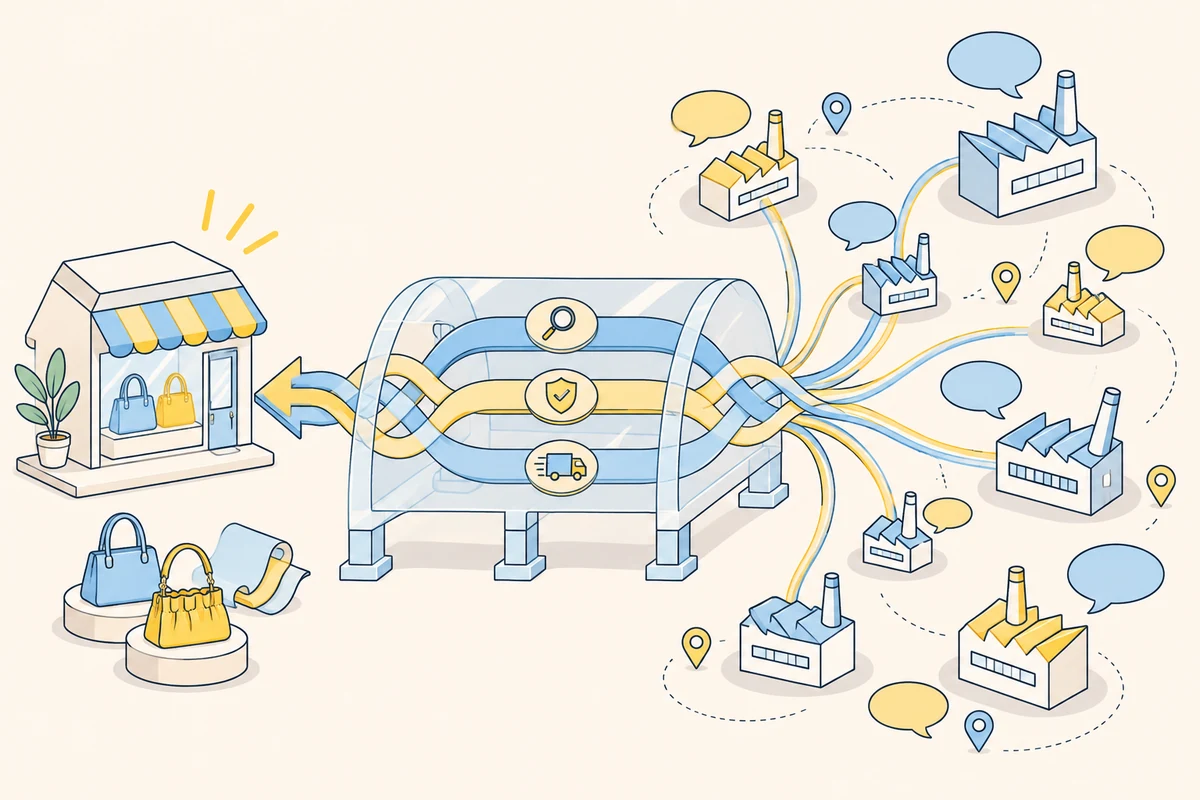
The strategic bet sits in a difficult middle layer. Small retailers want access to products without hiring a sourcing team or ordering factory-scale quantities. Factories can make goods at competitive prices but are spread across languages, locations and different operating standards. An intermediary can coordinate that work and reduce search costs. It must also take on the messy parts buyers used to handle themselves: vetting, sampling, consolidation, inspection, freight, returns and the consequences of a delayed or faulty order. Everful’s pitch is that AI agents can make this system responsive enough to serve businesses too small for a global procurement department.
From a jewellery catalogue to sourcing infrastructure#
Everful started as a jewellery wholesale business in 2024 before expanding into a multi-category, factory-direct sourcing platform. Its co-founder Sisi Song previously worked at Alibaba and as an investor at Bessemer Venture Partners. Kevin Han, the other co-founder, is an AI entrepreneur whose earlier startup Orbeus was acquired by Amazon. That background gives the company experience in cross-border commerce and technology, while the transition from a single product category into a broader platform changes what the company has to operate. Everful’s company description
The company says its catalogue now contains over 20 million products across wholesale, dropshipping and customization. Its consumer-facing site also says more than 10,000 new stock-keeping units are added daily and describes no minimum order quantity for most items. Those claims make the service legible to a small retailer: it can inspect a broad range, place a smaller order and have fulfilment arranged. But a large catalogue is a discovery metric. It does not tell a buyer whether an item is available when needed, whether the sample matches the delivered batch or whether a popular product can be replenished on schedule.
Sourcing is a sequence of decisions, not simply a search box. A retailer needs to turn an idea into a product specification, find capable factories, compare quotes, evaluate samples, negotiate order terms, check production and coordinate shipping. An online marketplace can make supplier information easier to find. The buyer still needs to figure out which supplier can meet a requirement and what happens after money changes hands. Everful’s founders argue the company takes on more of that work, while platforms such as Alibaba connect buyers and suppliers and Faire helps retailers buy wholesale inventory from brands. These models overlap in discovery but assign operational responsibility differently. TechCrunch’s description of the sourcing model
Everful says its agents track consumer trends, identify and vet factories, coordinate communication across orders and manage logistics. The company calls the data system behind these functions a “world model” of supply and demand. It is meant to represent what buyers want, what factories can produce and how goods move between them. A useful model of this kind needs structured evidence from orders, inspections, availability and delivery outcomes. Each transaction can improve a future recommendation if the records are accurate and consistently connected to a factory, product variant and customer requirement.
The phrase “AI infrastructure” describes an ambition, while the disclosed operation is a blend of software, employees and suppliers. Everful says it employs about 70 full-time staff, 45 in research and development, and has an AI operations team linking engineering with business work. This organisation itself is evidence about where the product’s costs may sit. AI can reduce the effort needed to scan catalogues or prepare supplier messages. Quality decisions, disputed shipments and unusual production issues may still need people who understand the item and the contract. A platform can scale the interface while the service underneath remains operationally intensive.
The order matters more than the listing#
The buyer’s experience is determined after a product is chosen. A factory quote may use a different material, tolerance, finish or packaging than the retailer requested. A photograph or product title cannot settle those details. A sample can show what one unit looks like, but not by itself establish that a later bulk run will match it. Inspection data can help make the process more predictable, provided the inspection samples the right defects and is attached to the actual production batch. Everful says it scores factory quality using information from its own inspections. The company has not published enough detail in its financing announcement to assess those scores or compare them with an independent quality benchmark.
Order consolidation creates both convenience and coordination. Combining goods from multiple suppliers can reduce fragmented communication and provide a single workflow for a retailer. It also adds dependencies. If one supplier misses a production date, the combined order can be held up. If products arrive in separate parcels, freight and customs timing can differ. If a customization needs approval, one late decision can shift the delivery date. A sourcing service has to manage these connections and explain which party bears the cost of changes, defects or delays.
Low minimum orders can help a new brand test demand without committing too much cash to one design. They can also increase the number of small transactions a sourcing platform has to coordinate. Factories have setup costs, production schedules and minimum-efficient batches of their own. Retailers might obtain flexibility through pooled orders or ready inventory, but the product’s availability and pricing will depend on the actual arrangement. “No minimum” for most catalogue items does not necessarily mean custom manufacturing has no minimum, nor that every item can be reordered in small quantities at the same price. The conditions by product and service will determine the real flexibility.
A retailer’s working capital is the central financial customer problem. Money paid for inventory is unavailable for payroll, rent and marketing until those goods sell. Ordering too much can trap cash in slow-moving stock. Ordering too little can miss a trend or require costly replenishment. A sourcing platform can reduce search time and perhaps shorten replenishment. It cannot remove the demand uncertainty that makes inventory risky. To show the service improves a retailer’s economics, Everful would need evidence on factors such as lead times, reorder rates, minimum quantities, defect rates and sell-through, not only the number of products it lists.
The company’s claim of more than five million shipped pieces each month suggests significant throughput across its customer base. Scale can help identify repeat suppliers and commonly ordered products. However, pieces shipped are not the same as profitable orders. The number does not disclose average order size, average selling price, returns, cancellations, shipping subsidies or how revenue is split between product value and service fees. It also does not show whether growth is concentrated in a few large brands or spread among small retailers. Those details affect both resilience and margin.
The difference between items listed and items shipped is another useful dividing line. A catalogue can grow quickly as suppliers upload products, while only a smaller subset receives recurring orders. A system that learns from genuine purchase, inspection and replenishment data has more commercial signal than one that mainly learns from clicks or catalogue searches. Everful says its model is built around supply and demand, but the release does not disclose how much of its 20-million-item catalogue has active stock, verified specifications or recent delivery history. Those are practical indicators for whether breadth turns into dependable selection.
A revenue run rate is an early signal#
Song told TechCrunch that Everful was on pace for $100 million in annualized revenue by year-end, less than two and a half years after launch. The number is ambitious, and the timeline is short for a company handling physical goods across borders. Still, annualized revenue needs a careful definition. It usually projects a recent revenue pace over a full year, which can be informative about momentum. It does not equal audited full-year revenue or cash collected. The article does not report a valuation, an audited income statement, the round’s dilution or an operating margin. The Series A amount and the revenue pace are evidence of investor backing and claimed commercial activity, not a complete financial picture.
The business might earn revenue through product margins, service fees, fulfillment charges or several components together. The sources do not fully disclose that mix. Each structure creates a different incentive. A margin on goods can reward finding cost savings but make landed cost less transparent. A service fee can make the charge clearer while requiring the company to prove that coordination saves more than it costs. A fulfillment fee ties revenue to order volume and logistics performance. Retailers need to know the delivered price, not simply factory price, to compare the service with sourcing directly or through other channels.
The Series A was led by two investors and included two existing backers. The release does not disclose the company’s post-money valuation or financing terms. Without those terms, the amount raised cannot show whether the founders sold a small or large share, nor can an outside reader calculate a valuation multiple from the $100 million run-rate claim. Those numbers often become shorthand for success, yet each is a separate variable. The financing gives Everful resources for expansion; future filings or company disclosures will need to show how those resources translate into durable margin and cash flow.
Everful plans to expand its presence in the United States, which it calls its largest market, and in Europe, particularly the U.K., France and Italy. It also says it will invest in AI automation for product customization and sourcing workflows, and deepen e-commerce integrations beyond its Shopify integration. These plans make sense as uses of a round for a cross-border platform. Each market adds taxes, product standards, shipping options and customer support needs. Integrations can reduce duplicate data entry, but they also create maintenance work as retailers’ order systems change.
The AI investment has a specific economic hurdle. Automating catalogue translation or product discovery can reduce time spent per order. Automating factory communication can help coordinate suppliers across time zones. But order exceptions, quality disputes and returns generate work that is hard to standardize. The more Everful promises to handle everything from sourcing to delivery, the more its unit economics depend on how often those exceptions occur and how much manual intervention they require. A rising shipment count will be valuable if revenue grows faster than the cost of serving it.
Cross-border trade turns into operating risk#
Everful sources from Chinese factories, which ties its costs and customer propositions to trade conditions. Song told TechCrunch that the founders have considered geopolitical issues from the beginning. She cited the suspension of the U.S. de minimis exemption, which had allowed qualifying shipments valued at $800 or less to enter the United States duty-free, as an example of policy change affecting the business. Current U.S. Customs and Border Protection guidance says eligible imports at or below that threshold are now subject to applicable duties, taxes and fees, subject to stated exemptions and entry rules. Changes in tariff treatment can alter the landed price for a small order and the benefit of consolidating shipments. The company’s response is to support local retail sales using overseas sourcing. The effectiveness of that model depends on the actual product mix, customs handling and supplier alternatives. CBP guidance on de minimis suspension
This exposure is not unique to Everful, but its small-retailer customers may have less capacity to absorb unexpected changes. A large buyer can negotiate, diversify or hold buffer inventory. A small shop can be more exposed to a delay or a sudden landed-cost increase, though the exact effect varies by product and shipping method. A platform can provide information and coordination, but it cannot guarantee that tariffs, customs procedures or supplier terms remain stable. A resilient sourcing network would need alternative factories, transparent landed-cost estimates and clear communication when prices change.
Factory verification also has to keep pace with network expansion. “More than 30,000 vetted factory partners” is a meaningful scale claim, but vetting can mean different things: identity checks, capacity review, compliance documents, sample quality or ongoing inspection. A retailer needs to understand what was checked and when, and what the platform does if a factory’s performance changes. Continuous factory scoring may provide a feedback loop. Its usefulness depends on data quality, inspection frequency and whether a score predicts the problems buyers actually care about.
The stated world model of supply and demand will be judged by decisions, not by the metaphor. Does it surface a factory that can meet a product specification? Does it predict which ready-stock item can arrive before a seasonal window? Does it keep customization from drifting between sample and production? Does it coordinate an order across suppliers without increasing total landed cost? Those are observable operational questions. Data can compound as orders, inspections and deliveries accumulate, but only if outcomes are recorded consistently and the system can distinguish a supplier issue from a changing customer request.
Customer trust is part of the product#
Everful’s pitch centres on responsibility. Its co-founder told TechCrunch that the company handles sourcing, order consolidation, quality control and logistics, rather than simply listing suppliers. A small retailer without procurement staff can value one accountable workflow. That promise also raises a question about recourse. If a shipment arrives late or fails inspection, the buyer needs to know who investigates, what remedy is available and how quickly the issue is resolved. The quality of the sourcing interface is inseparable from the dispute process that follows an imperfect order.
The platform must be legible to both sides. Retailers want comparable quotes, production status and delivery estimates. Factories need specifications that do not change ambiguously between an inquiry and a purchase order. AI translation can help bridge language gaps, but a mistranslated size, material or certification requirement can create expensive consequences. A workflow that turns unstructured messages into order details should preserve approvals and make changes visible. The source material describes agentic coordination, but it does not yet provide measured error rates for these handoffs.
Consolidation also makes responsibility a design choice. A retailer may place one request that becomes several factory orders, inspections and parcels. If one item is late, the customer needs to know whether the entire shipment is held, whether partial delivery costs more and who updates the sales plan. The platform can absorb some coordination, but it cannot make the underlying factories share one production calendar. Service-level promises, exception handling and refunds become part of the product. Repeat purchasing will depend on how those rules work when an order does not follow the smooth path described in a launch release.
Small businesses may value breadth and flexibility more than a huge catalogue. A retailer deciding between twenty million listings still needs useful filters, accurate stock status and confidence that the pictured product matches delivery. The company's own site highlights ready-to-ship stock, limited or zero minimums for most products, secure payment and flexible shipping. These are product promises that customers can test order by order. A growing catalogue is a supply-side asset only when product information and fulfilment remain reliable.
What the funding round establishes#
The financing gives Everful $48.5 million to expand an operating sourcing platform. The company discloses a large network, monthly shipment activity and a revenue run-rate target. Independent reporting adds that it began with jewelry wholesale, competes in a market that includes Alibaba and Faire, and faces trade-policy exposure because of its China-based factories. Together, those facts support a substantive claim: Everful is scaling a service that combines software and physical commerce, not merely releasing an AI assistant.
The record does not establish the valuation investors accepted, the profitability of each order, the independently audited revenue, retailer retention or the error rate of supplier and quality workflows. Those are the measures that will distinguish a technology-assisted marketplace from durable infrastructure. The company says each order and inspection improves its model. Investors will eventually need to see that learning translate into lower fulfilment costs, better quality, repeat purchasing or improved margins.
The next milestones are concrete. The company can report how annualized revenue converts into full-year recognised revenue, whether U.S. and European expansion keeps delivery performance stable, and how much customization becomes automated without raising defect rates. It can disclose repeat-order share, gross profit per order or fulfilment cost as shipment volume grows. Retailers will evaluate whether low minimums, factory access and managed delivery save cash and time after freight, duties and exceptions are counted.
A growing network can create better matching if the data become more useful with each transaction. It can also create a maintenance burden: supplier capacity changes, catalog entries expire, products diverge from their samples and inspection quality varies. The company says factories are vetted and continuously scored using its own inspection data. Outside buyers will want to know whether that score predicts on-time, specification-compliant orders across categories and regions. If a high score is mainly an internal label, it offers less assurance than a published measure tied to deliveries and defects.
Everful is betting that an AI model can coordinate work that once needed a sourcing team. The Series A funds that attempt at scale. The practical promise is not that software can find a factory in a catalogue; it is that a small retailer can trust the path from product idea to delivered inventory. The round marks investor confidence in that promise. Whether it becomes a resilient business will depend on the less glamorous variables: cost per successful order, quality consistency, inventory risk and the ability to keep a factory network dependable as trade conditions change.